
 get the app
Amountle Unlimited
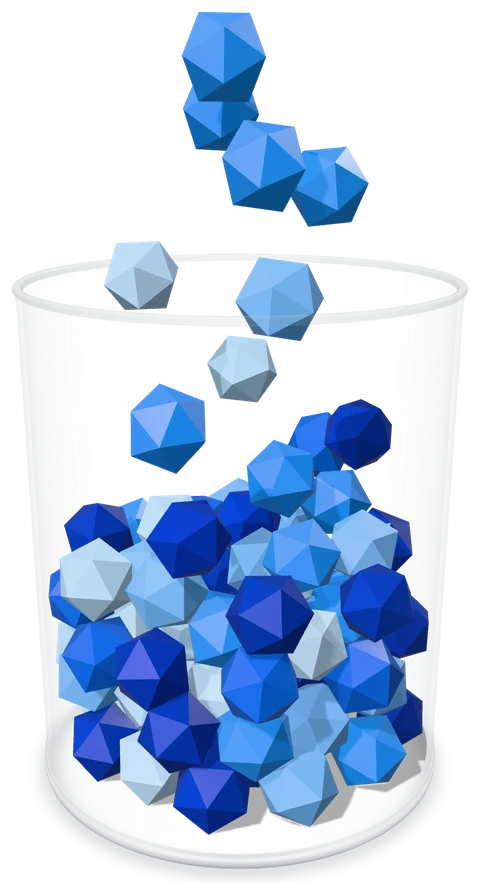
Amountle Unlimited is the free guess how many in the jar game. Candy, nuts, rubber ducks and shapes pour into a glass jar, the pile settles, and you have 15 seconds to estimate how many are inside. Every run is a fresh set of five jars, so you can keep playing as long as you like.
If you saw a video of objects pouring into a jar with people shouting out their guesses and wanted to try it yourself, this is that game. Press play above and make your first guess. No download, no account and no daily limit.
- 5jars in every run
- 15 secto make each guess
- 100points a jar, plus a bonus for exact
What is the jar guessing game?
Guessing how many things are in a jar is one of the oldest games around. Fairs, school fundraisers, baby showers and office parties have run jelly bean jar contests for generations. Whoever writes down the number closest to the real count wins the jar.
Amountle turns that classic into a fast online estimation game. Instead of one jar on a table, you get a steady stream of new piles that pour in front of you with real physics. Each object tumbles, bounces and settles the way it would in real life, so the pile looks different every time. You make your guess, the objects count back out one at a time, and you see straight away how close you were.
The same idea has spread through short viral videos where a jar, cup or box fills with objects and viewers race to guess the total in the comments. People search for it as the jar game, the amount game, the estimate the items game, the how many inside game and the guess the number of objects game. They all mean the same thing, and Amountle Unlimited is a free place to play it whenever you want.
How to play Amountle
- Press play. A container appears and the objects start pouring in.
- Watch the pour. Pay attention to how fast the pile grows and how big each object is.
- Spin the container. Drag it, or use the arrow keys, to see the pile from every side. Press space to give it a shake.
- Type your guess. Once the pile settles you have 15 seconds. Use the plus and minus buttons or type the number and press submit.
- See the count. The objects leave the jar one by one while the real total ticks up, and you get your points.
- Finish the run. After five jars the results screen shows every guess next to the real number. Press play again for a brand new set.
Amountle works with a mouse, a keyboard or a touch screen. On a phone the number pad sits right under the jar so you can tap your guess with one thumb.
How scoring works
Each jar is worth up to 100 points. The closer your guess is to the real count, the more of those points you keep. Points fall away as your guess drifts further from the answer, so being a little off still pays, while a wild guess earns little or nothing.
Hitting the number exactly earns a bonus worth one third of the object count. That means an exact guess on a pile of 300 is worth far more than an exact guess on a pile of 30. A perfect run of five jars is rare, which is what makes it worth chasing.
| Your guess | What happens |
|---|---|
| Exact | Full 100 points plus a bonus of one third of the count |
| Very close | Most of the 100 points |
| In the right area | Some points for that jar |
| Far off | Few or no points |
| No guess in time | Nothing for that jar |
Over Under, Endless and Practice
Over Under
The pile pours in and a number appears. You answer one question. Is the real count over that number or under it? It's quicker than typing a guess and a good way to build a feel for big and small piles.
Endless
New jars keep coming for as long as your guesses stay close enough. One bad miss ends the run. Endless rewards steady, careful estimating over lucky shots.
Practice
Five jars with no timer at all. Take as long as you like, spin the jar from every angle and try out counting methods. Practice is the best way to learn how many of each object fit in each container.
What pours into the jar
Every jar is filled with one kind of object, and the size and shape of that object changes everything. Here are some of the things you'll see.
- Candy and sweets like gummy bears, gumdrops, chocolate buttons, butterscotch discs, wrapped toffees, licorice pieces, peach rings and marshmallow twists
- Snacks like popcorn, pretzels, cheese crackers, sandwich cookies and dinosaur nuggets
- Nuts and fruit like cashews, pistachios, berries and citrus wedges
- Toys like rubber ducks
- Shapes like balls, cubes and pyramids in bright colors
The containers change too. You'll guess piles in tall jars, wide glasses, cups and boxes. A tall narrow jar can trick you into guessing high, while a wide shallow container often holds more than it looks.
How to estimate how many are in a jar
You can't count every piece in 15 seconds, and you don't need to. These are the methods good estimators use, for this game and for real jar contests.
1. Count a layer, then count the layers
Look at the bottom or the top of the pile and roughly count how many pieces make up one layer. Then look from the side and count how many layers tall the pile is. Multiply the two. This simple trick gets you close on almost any jar.
2. Count a small patch and scale it up
Pick a small patch on the side of the jar, maybe a tenth of the visible surface, and count the pieces in it. Multiply to cover the whole surface you can see, then add extra for the pieces hidden in the middle.
3. Use volume and packing
Real objects never fill a jar completely. There is always air between them. Round objects like balls and gumdrops fill roughly 60 to 65 percent of the space, while flat or odd shapes can fill less. To estimate, divide the volume of the filled part of the jar by the volume of one piece, then multiply by about 0.6. The answer is your rough count.
4. Compare with a jar you already know
Every time a count is revealed, remember it. After a few rounds you'll know that a half full jar of ducks is around a certain number and a full jar of candy is many times more. Comparing against piles you've already seen is the fastest method of all.
A worked example
Say a jar fills with round gumdrops. Looking down from the top you count about 12 across one layer. Spinning the jar to the side you count about 9 layers from the bottom to the top of the pile. Twelve times nine is 108. The pile is a little wider in the middle than at the top, so you bump it up and guess 115. If the real count is 112, you've landed within three and kept most of your points.
Now try a jar of rubber ducks. They're big and awkward, so far fewer fit. Maybe 5 across a layer and 6 layers tall makes 30. Big objects make small numbers, and small numbers are where an exact guess becomes very possible.
Tips to guess closer
- Don't count one by one. There isn't time. Use layers or patches instead.
- Spin the jar. A side view shows how tall the pile is, and a top view shows how wide it spreads.
- Shake it. A shake settles the pile and closes gaps, which makes layers easier to see.
- Watch the pour. How long the pour lasts is a clue. A long steady stream means a big number.
- Guess a little higher. Most people guess low, because the middle of the pile is hidden from view.
- Learn from every reveal. The count out after each jar is free training for your eye.
- Use Practice. With no timer you can test each method and see which one works best for you.
Common estimation mistakes
Forgetting the hidden middle. You only see the pieces pressed against the glass. Plenty more sit inside where you can't see them, which is why guesses tend to come in too low.
Being fooled by the container. Tall thin jars look like they hold a lot, and wide low bowls look like they hold a little. Think about the space inside, not the height.
Ignoring object size. Two jars that look equally full can hold wildly different numbers if one has candy and the other has toys.
Rushing the guess. Fifteen seconds is longer than it feels. Take a breath, do one quick layer count, then type.
Classrooms, parties and fundraisers
Estimation jars are a favorite in math lessons. Teachers use them to build number sense, practice multiplication and talk about volume. Amountle works on a classroom screen too. Put a jar up, let everyone write a guess, then reveal the count together. Over Under is perfect for quick class votes.
At parties and baby showers the guess how many candies in the jar game is a classic icebreaker. Amountle Unlimited gives you endless rounds of it with no candy to buy and no counting by hand afterwards. It's also a handy warm up before a real jelly bean contest at a fair or fundraiser, because the methods on this page work just as well on a real jar.
Estimating is a real skill. Builders, shop owners, scientists and cooks all make quick guesses about amounts every day. A few rounds of Amountle a day is a fun way to get sharper at it.
What people search for
People find Amountle with all kinds of searches, often after seeing a jar filling up in a video without knowing the game's name. These all lead to the same free game.
| What people search | What you get here |
|---|---|
| amountle | The jar estimation game, free with no daily limit |
| amountle unlimited | A new run of five jars every time you press play |
| guess how many in the jar game | Watch the pour, then guess the count |
| how many in the jar game | Objects pour into a jar and you estimate the total |
| how many inside game | Guess how many objects are inside the container |
| jar guessing game online | Play in your browser on any device |
| jar game from the viral videos | The same pour and guess idea you can play yourself |
| estimate the items game | Estimate the number of items in each pile |
| amount game | Guess the amount of objects in the jar |
| amount box game | Jars, cups and boxes fill up and you guess the amount |
| estimation game online | Five jars, 15 seconds each, points for close guesses |
| estimation jar game | Endless estimation jars with instant answers |
| how many jelly beans in a jar game | Candy, nuts, ducks and shapes in real physics jars |
| guess how many candies in the jar | Gummy bears, gumdrops, toffees and more |
| guess the number of objects game | Guess the exact count to win a bonus |
| counting game for adults | Quick rounds that get harder as piles grow |
| how many balls in the jar game | Balls and other shapes pour in and settle |
| guess the count game | See the real count after every guess |
| over or under jar game | Over Under mode, one tap per jar |
| jar estimation for kids and classrooms | Practice mode with no timer |
| pour and guess game | Watch it pour, then make your guess |
| how many are inside the cup game | Cups and glasses as well as jars |
Frequently Asked Questions
What is Amountle?
Amountle is a free estimation game. Objects pour into a glass container and you guess how many are inside. The closer your guess, the more points you score.
What is the game where you guess how many things are in a jar?
It's often called the jar guessing game or the estimation jar game. Amountle Unlimited lets you play it online for free, with a new jar every round.
Is this the jar game from the viral videos?
It's the same idea. Objects pour into a jar, the pile settles and you guess the count. Here you can play as many rounds as you want.
Is Amountle Unlimited free?
Yes. It's free to play with no account and no daily limit, so you can start a new run of five jars whenever you like.
How long do you get to guess?
After the pour settles you have 15 seconds to type your estimate. Practice has no timer.
How is Amountle scored?
Each jar is worth up to 100 points, and closer guesses earn more. An exact guess adds a bonus of one third of the object count.
How do you estimate how many are in a jar?
Count how many pieces make up one layer, count how many layers tall the pile is, and multiply. Add a little extra for the pieces hidden in the middle.
What is the trick to guessing jelly beans in a jar?
Work out the volume of the jar, divide by the volume of one bean, and multiply by about 0.6 because of the air between them. The layer method works well too.
Why do people usually guess too low?
You only see the pieces against the glass. Many more sit in the middle out of sight, so most first guesses come in under the real count.
Can I rotate the jar?
Yes. Drag the jar or use the arrow keys to spin it, and press space to give it a shake.
What are Over Under, Endless and Practice?
Over Under asks whether the pile is above or below a number. Endless keeps going until you miss. Practice gives you five jars with no timer.
What objects are in the jars?
Candy like gummy bears and gumdrops, snacks like popcorn and pretzels, nuts, fruit, rubber ducks and colorful shapes such as balls and cubes.
Is it always a jar?
No. You'll also see glasses, cups and boxes. The shape of the container changes how big the pile looks, which is part of the challenge.
Should I count the objects one by one?
No. There isn't time. Estimate from the size of the pile, the size of each object and how full the container looks.
Can I play Amountle more than once a day?
Yes. Amountle Unlimited has no daily limit. Every time you press play you get a new run of five jars.
Is Amountle good for kids and classrooms?
Yes. It builds number sense and estimation skills, and Practice mode removes the timer so younger players can take their time.
Can I use it for a party guessing game?
Yes. Put it on a big screen, let everyone call out a guess, then watch the real count. Closest guess wins the round.
Do I need to download anything or sign up?
No. Amountle runs right in your browser with nothing to install and no account needed.
Does Amountle work on my phone?
Yes. It runs in any modern browser on phones, tablets and computers.
Is there a dark mode?
Yes. Use the switch at the top of the home screen to swap between dark and light.